
The Mental Health Habits Moms Quietly Swear By
Motherhood can be deeply rewarding and relentlessly demanding at the same time. A normal day can involve feeding people, remembering appointments, answering work messages, finding missing shoes, managing emotions, cleaning something that was clean ten minutes ago, and making dozens of tiny decisions nobody else even notices.
By Brady Rivera on August 19, 2026
Motherhood can be deeply rewarding and relentlessly demanding at the same time. A normal day can involve feeding people, remembering appointments, answering work messages, finding missing shoes, managing emotions, cleaning something that was clean ten minutes ago, and making dozens of tiny decisions nobody else even notices.
Against that background, advice about mental health can sometimes feel wildly unrealistic. A two-hour morning routine, daily meditation session, elaborate journaling practice, and perfectly scheduled self-care may sound wonderful, but many mothers are working with much smaller pockets of time.
The habits that actually help are often less impressive. They are small ways of creating breathing room, reducing unnecessary pressure, and remembering that the person taking care of everyone else is still a person too.
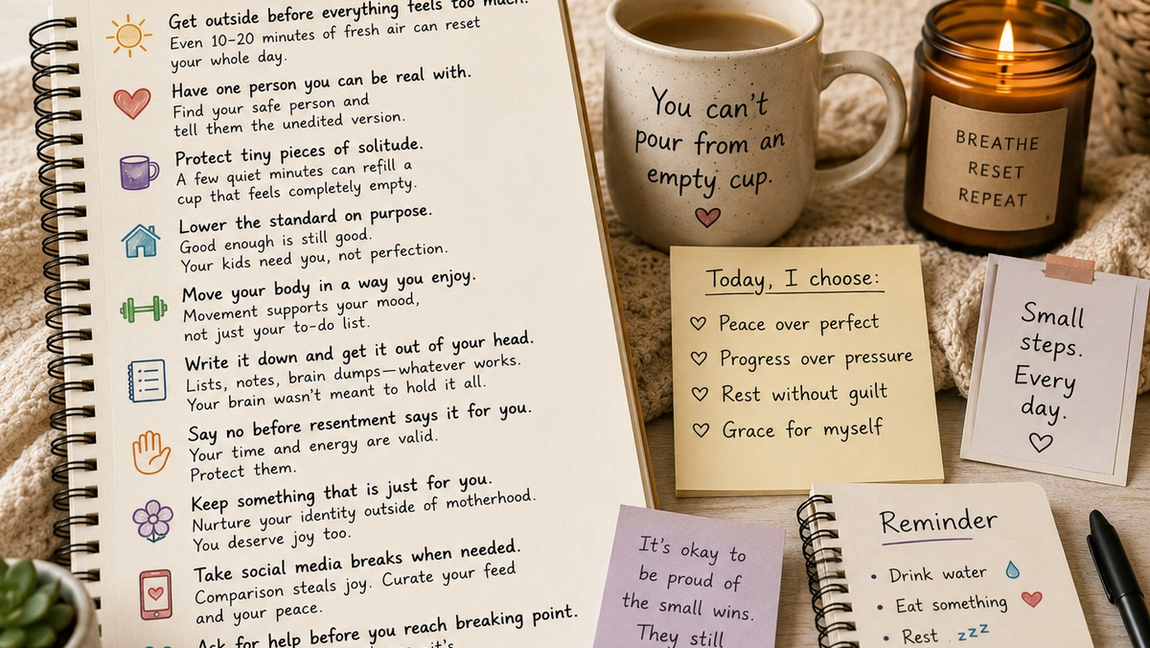
Getting outside before everything feels too much
There is a reason a walk appears so often in conversations about feeling better. It is simple, accessible for many people, and combines movement, daylight, a change of environment, and often a break from whatever was becoming overwhelming indoors.
For moms with babies or young children, a stroller walk can be especially useful because nobody needs to arrange childcare first. With older children, walking alone can become valuable time to think without interruption.
It does not need to be long or particularly athletic. Ten or twenty minutes outside can create a noticeable break in a difficult day.
The important part is treating the walk as something worth doing even when there are dishes in the sink and laundry waiting.
There will almost always be something more productive you could technically be doing. That does not automatically make it more important.
Having one person you can tell the unedited version to
Everyone needs at least one relationship where they do not have to perform competence.
Maybe it is your partner, sister, friend, another mom, or someone you have known for years. The important thing is being able to say, “Today was awful,” without immediately needing to explain that you also love your children very much.
Motherhood can become isolating when everyone shares only the polished version.
A five-minute voice message to someone who understands can sometimes provide more relief than an hour spent silently replaying everything in your own head.
Connection does not always require solving the problem. Sometimes another person simply confirming that a difficult day was genuinely difficult is enough to make you feel less alone inside it.
Protecting tiny pieces of solitude
Many mothers do not need an elaborate self-care day as much as they need fifteen minutes when nobody is asking them a question.
Solitude becomes surprisingly valuable when your days involve constant physical and emotional availability.
Maybe you drink your morning coffee before everyone wakes up. Perhaps your partner handles bedtime while you take a shower without rushing. Maybe you sit in the car for five minutes after arriving somewhere.
These tiny pockets of quiet can help your nervous system come down from the constant stimulation of parenting.
The key is not automatically filling them with chores.
If every moment without children becomes an opportunity to become more productive, you never actually experience being off duty.
Lowering the standard on purpose
A surprising amount of mental pressure comes from maintaining standards nobody explicitly required.
The house should be clean. Meals should be healthy and homemade. The children should have enriching activities. Birthdays should feel magical. You should answer messages quickly, maintain friendships, exercise, succeed at work, and somehow enjoy every minute because “they’re only little once.”
Something eventually has to give.
Choosing “good enough” intentionally can be incredibly freeing.
Dinner can occasionally be something extremely simple. Toys can stay on the floor overnight. You can decline an invitation because the week is already too full.
Lowering unnecessary standards is not giving up. It is deciding where your limited energy actually deserves to go.
Moving without turning it into another obligation
Movement can support mental well-being, but exercise becomes much less helpful when it turns into another standard you are failing to meet.
Choose something that fits your life.
Walk while listening to a podcast. Do twenty minutes of strength training at home. Stretch before bed. Go for a run if running genuinely clears your head. Dance around the kitchen with your children.
The goal does not always have to be changing your body.
Sometimes movement is simply a way to get out of your thoughts for a while and return to your body.
That shift can be especially valuable on days when your brain feels crowded with responsibilities.
Writing things down instead of carrying everything mentally
The mental load of motherhood can make the brain feel like a browser with forty tabs open.
Appointments. Groceries. School forms. Clothes the kids need. Someone’s birthday. A work deadline. A message you forgot to answer.
Trying to remember everything creates constant background tension.
Externalize it.
Use a notes app, paper planner, shared calendar, or simple running list. The exact system does not matter nearly as much as trusting that information lives somewhere other than your head.
Writing worries down can help too. Sometimes seeing a thought on paper makes it easier to distinguish between a real problem requiring action and something your brain is simply looping through.
You do not need an elaborate journaling practice. A messy list counts.
Saying no before resentment says it for you
Many mothers become very good at accommodating everyone else.
You agree to the gathering. Volunteer for the task. Host the dinner. Take on another responsibility because technically you could make it work.
Then you resent the entire thing.
One useful mental health habit is learning to notice that feeling earlier.
Before saying yes, ask whether you actually have the capacity. Not whether you could physically squeeze it into the calendar, but whether adding it would make your life unnecessarily harder.
Saying no does not require a dramatic explanation.
Protecting your energy before you become completely depleted is much easier than recovering after you have given all of it away.
Keeping something that has nothing to do with motherhood
It is easy for motherhood to consume identity.
Your conversations become about sleep schedules, childcare, school, meals, milestones, and logistics. Your phone fills with pictures of your children. Your free time becomes family time.
Keep something that belongs to you.
Read books. Take a class. Work toward a career goal. Paint. Garden. Run. Travel with friends occasionally. Learn something simply because it interests you.
It does not need to be productive or impressive.
Having interests outside motherhood does not make you less devoted to your children. It reminds you that becoming a mother expanded your identity rather than replacing it.
Taking social media breaks when comparison gets loud
Social media can provide community, humor, and genuinely useful parenting information. It can also make an ordinary Tuesday look inadequate.
Someone else’s children are eating beautifully arranged vegetables. Their house is spotless. They are exercising at sunrise, traveling constantly, and apparently enjoying an uninterrupted marriage.
You are seeing selected moments.
If scrolling regularly leaves you feeling worse about your parenting, appearance, home, career, or relationship, step away for a while. Unfollow accounts that consistently trigger comparison.
Your mental environment matters too.
You are allowed to curate what gets access to your attention.
Asking for help before reaching breaking point
One of the most important mental health habits is also one of the hardest: asking for help early.
That might mean telling your partner you need more practical support, asking family to watch the children, paying for help if it is available to you, or talking with a healthcare or mental health professional.
Persistent sadness, anxiety, anger, hopelessness, panic, emotional numbness, or feeling unable to cope deserves attention, particularly during pregnancy and the postpartum period.
Mental health support does not have to be reserved for a crisis.
Sometimes the most useful intervention happens much earlier, when you first realize that something has been difficult for longer than you expected.
Building a life with regular recovery
The best mental health habits are not necessarily the most aesthetically pleasing ones.
They are the habits that reduce the distance between becoming depleted and getting a chance to recover.
A walk. A conversation with someone safe. An hour alone. A simpler dinner. A boundary. A workout you actually enjoy. Going to bed instead of cleaning the kitchen.
None of these will make motherhood effortless.
But small habits repeated consistently can make difficult seasons easier to carry.
You do not need to wait until you are completely overwhelmed before taking care of your mental well-being. In fact, the quiet habits that work best are often the ones that happen long before anyone else realizes you needed them.


