
How to Handle Screen Time Without Starting a War
Few parenting topics can turn an ordinary afternoon into a negotiation quite like screen time. One minute your child is happily watching a show or playing a game. The next, you say it is time to stop, and suddenly you are apparently responsible for the greatest injustice in human history.
By Enzo Hodge on August 19, 2026
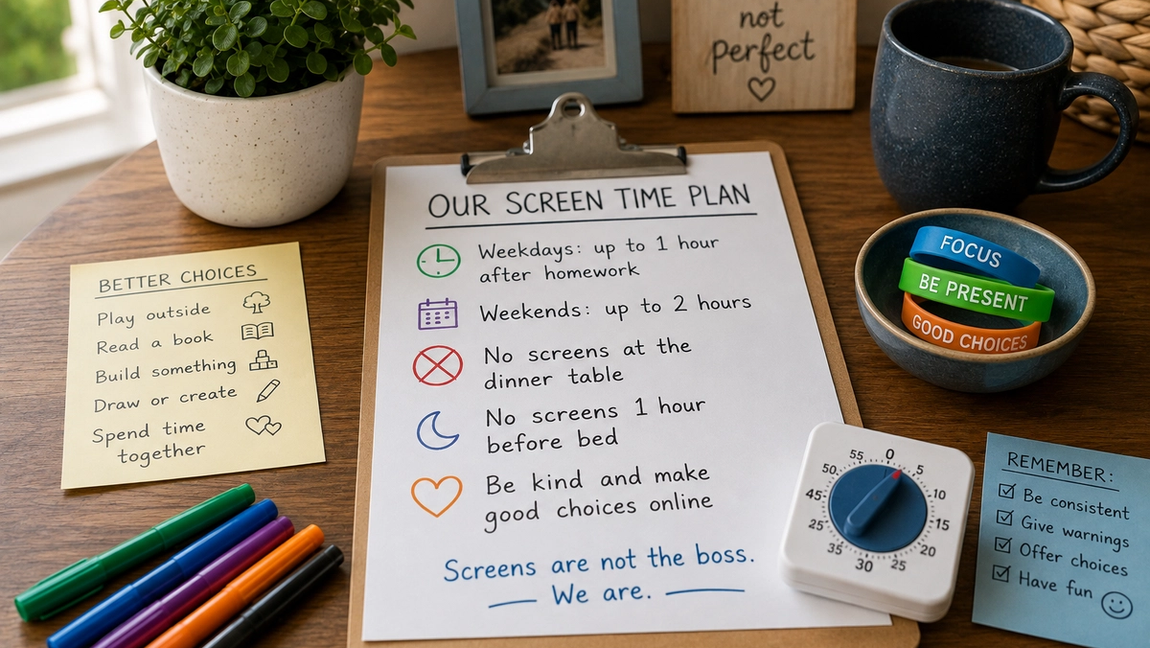
Few parenting topics can turn an ordinary afternoon into a negotiation quite like screen time. One minute your child is happily watching a show or playing a game. The next, you say it is time to stop, and suddenly you are apparently responsible for the greatest injustice in human history.
Screens are also complicated because they are not inherently bad. Children use them for entertainment, school, creativity, communication, and sometimes simply because parents need twenty uninterrupted minutes to make dinner. Trying to eliminate screens entirely is unrealistic for most modern families.
The more useful goal is helping children develop a healthy relationship with technology. That requires boundaries, but it also requires flexibility, consistency, and an understanding that managing screen time is about much more than counting minutes.
Decide what screen time is replacing
It is tempting to focus entirely on how many minutes or hours a child spends on a device, but context matters.
An hour watching a movie with the family is different from an hour endlessly scrolling short videos. Video chatting with grandparents is different from gaming alone late at night. Creating something digitally is different from passively consuming content.
Instead of asking only, “How much screen time is too much?” consider what the screen is replacing.
Is your child sleeping enough? Are they physically active? Do they play, read, spend time outside, interact with family, and maintain friendships? Can they tolerate boredom without immediately reaching for a device?
If screens consistently interfere with sleep, movement, school, relationships, or other important parts of childhood, that is a stronger signal that something needs to change.
Create predictable rules before screens turn on
The worst time to negotiate screen limits is usually when your child is already watching something.
Decide the rules beforehand. Perhaps screens are allowed after homework. Maybe devices stay away from the dinner table. Perhaps gaming happens for a set period on certain days, or tablets are used only after other responsibilities are finished.
Predictability reduces arguments because the limit stops feeling like a random decision made by the parent in the moment.
Younger children especially benefit from knowing exactly what will happen. “You can watch one episode, and then we’re getting ready for bed” is easier to understand than an unclear promise that they can watch “for a little while.”
When possible, give warnings before the end. A ten-minute warning followed by a two-minute reminder gives children time to mentally transition rather than suddenly having the device removed.
Do not make every transition a negotiation
If every screen-time limit changes after enough complaining, children quickly learn that the rule is simply the opening offer.
Consistency matters.
That does not mean you can never make exceptions. Staying up late to watch a family movie during vacation is different from extending gaming time every night because someone protests loudly enough.
The distinction should be clear: sometimes the family intentionally changes the rule, but arguing does not automatically change it.
When screen time ends, keep your response calm and relatively boring. Long debates can unintentionally turn the boundary into something negotiable.
You can acknowledge disappointment without reversing the decision. Your child is allowed to be unhappy that screen time is finished. Your job is not to eliminate every unpleasant feeling.
Make stopping easier by offering a next step
Turning off a screen creates an immediate gap. Children have been highly engaged, and suddenly they are expected to figure out what to do next.
Transitions often go more smoothly when there is something concrete waiting.
“Tablet time is finished. Do you want to help me make pancakes or go outside?” gives the brain somewhere else to go.
This is especially helpful with younger children, who may struggle to move independently from a stimulating activity into an unstructured one.
You do not need to entertain them constantly. Boredom is useful too. But during difficult transitions, having an appealing next activity can prevent the screen from feeling like the only interesting option available.
Create screen-free spaces and times
Some boundaries are easier to maintain when they apply automatically.
The dinner table can be screen-free. Bedrooms might remain device-free overnight. The first part of the morning or the hour before bedtime might happen without entertainment screens.
These rules protect specific parts of family life rather than requiring constant monitoring throughout the day.
Bedtime deserves particular attention because devices can easily push sleep later. A child who takes a phone or tablet into bed may continue using it long after parents think they have stopped.
Creating a charging station outside bedrooms can remove that nightly temptation for both children and teenagers.
Pay attention to what they are actually doing online
Screen-time conversations sometimes become so focused on duration that parents overlook content.
Know which games your children play, which platforms they use, what videos they watch, and who they communicate with. As children get older, conversations about privacy, advertising, inappropriate content, online strangers, cyberbullying, scams, and social media become increasingly important.
This does not require secretly monitoring every digital interaction forever.
The goal is gradually moving from supervision toward digital independence. Younger children need significant oversight. Teenagers need increasing privacy, but they still benefit from clear expectations and conversations about online risks.
Ask about their digital lives the same way you would ask about school or friendships. Technology is part of their world, and genuine curiosity makes it more likely they will come to you when something goes wrong.
Look at your own screen habits too
Children are exceptionally good at noticing hypocrisy.
It is difficult to convince them that phones should not be used during dinner when adults are checking messages between bites. Telling a teenager to stop scrolling while you spend the evening doing exactly that will probably not inspire enthusiastic cooperation.
Parents do not need identical limits because adults use devices for work, banking, navigation, communication, and household management. Still, explaining what you are doing can help younger children understand the difference.
It is also worth creating some family rules that apply to everyone. Maybe nobody brings phones to the table. Perhaps everyone puts devices away during family movie night or leaves them behind during a short walk.
Healthy technology habits are easier to teach when children can see them.
Expect different rules at different ages
A five-year-old and a fifteen-year-old should not have the same relationship with technology.
Young children generally need adults to create most of the structure. Older children can gradually become involved in deciding limits and managing their own habits.
With teenagers, strict control without conversation can easily become a constant power struggle. Instead, discuss why certain boundaries exist. Sleep, school responsibilities, safety, and respectful behavior provide much stronger reasoning than “because I said so.”
Give teenagers increasing independence when they demonstrate that they can handle it.
The eventual goal is not raising an eighteen-year-old who follows screen rules only because a parent enforces them. It is raising someone capable of noticing when technology is taking too much of their time and adjusting their own behavior.
Do not panic about imperfect days
Some days will involve more screens than you planned.
Someone is sick. The weather is terrible. You are traveling. Parents have deadlines. Everyone is exhausted. A movie marathon occasionally happens.
One screen-heavy Saturday does not determine a child’s relationship with technology.
Look at patterns rather than isolated days. If screens regularly dominate family life, interfere with sleep, or make every transition miserable, your routines may need adjusting. If your children otherwise have balanced lives, occasional flexibility is unlikely to undo everything.
Screen time does not have to become a daily battle between parents and children.
Clear expectations, predictable routines, appropriate content, and adults who model the habits they are asking for can remove much of the conflict.
The goal is not to make children dislike screens. Screens are fun—that is precisely why boundaries can be difficult.
The goal is to teach them that technology can be one enjoyable part of life without becoming the thing that controls all the others.


