
How to Discipline Without Yelling (Backed by Child Psychology)
Most parents do not plan to yell. It usually happens after the fifth ignored request, the third sibling fight, a rushed morning, or a bedtime that has somehow stretched another forty minutes. You start calmly, repeat yourself, feel your frustration rising, and eventually your volume rises with it.
By Aspen Cano on August 19, 2026
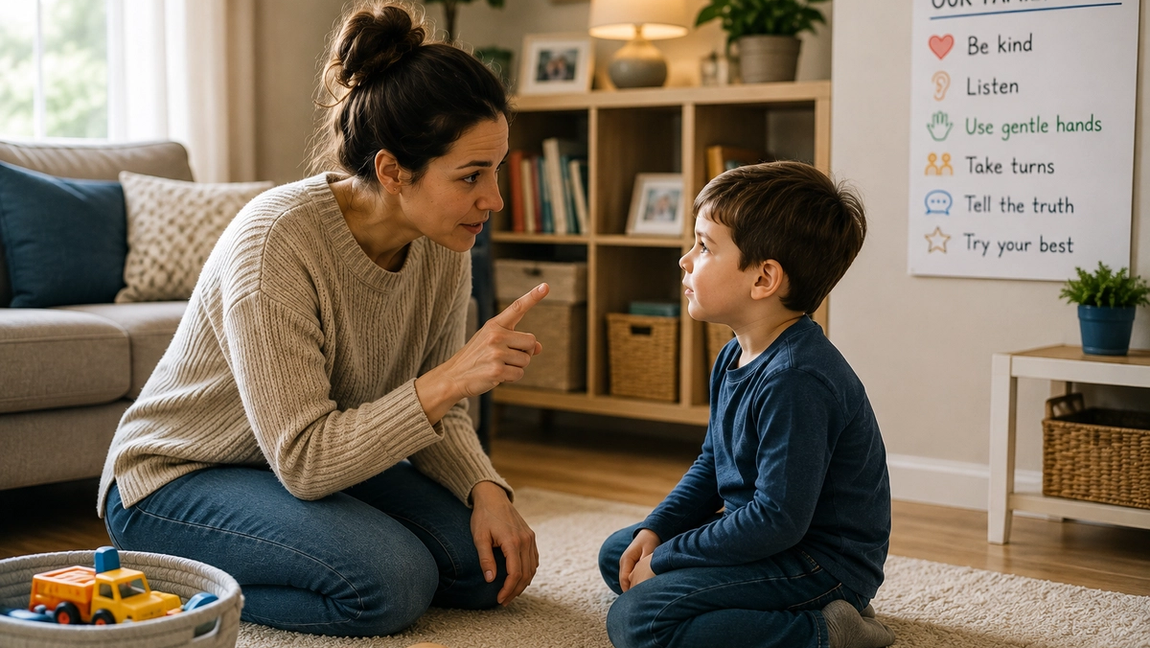
Most parents do not plan to yell. It usually happens after the fifth ignored request, the third sibling fight, a rushed morning, or a bedtime that has somehow stretched another forty minutes. You start calmly, repeat yourself, feel your frustration rising, and eventually your volume rises with it.
Yelling can sometimes produce immediate compliance because it gets a child’s attention. But immediate compliance is not the same thing as learning self-control. Research on parenting generally supports approaches built around warmth, clear expectations, consistent boundaries, and non-harsh consequences rather than frequent harsh verbal discipline.
The goal is not to become a parent who never gets angry. Anger is normal. The goal is learning how to hold a boundary without needing fear or volume to make it work.
Understand what is happening before correcting it
Behavior is easier to address when you understand what is driving it.
Young children have developing brains and limited impulse control. A toddler hitting another child may know hitting is wrong and still struggle to stop themselves when overwhelmed. An exhausted six-year-old melting down over putting on pajamas may be responding as much to fatigue as to the pajamas.
This does not mean inappropriate behavior should be ignored. Understanding behavior is not the same as excusing it.
Instead, it helps you choose a response that actually teaches something.
Before reacting, ask what might be happening underneath the behavior. Is your child tired, hungry, overstimulated, frustrated, seeking attention, struggling with a transition, or testing whether a boundary is real?
Sometimes the behavior still requires a consequence. But identifying the cause can help prevent the same situation tomorrow.
Use fewer words and clearer instructions
Parents often start explaining more when children are not listening.
Unfortunately, a long speech is rarely effective when a child is already emotional.
Keep instructions short and specific. “Please put your shoes by the door” is easier to process than a long explanation about why everyone is always late because nobody puts their things away.
Get physically closer rather than shouting from another room. Use the child’s name, make sure you have their attention, and give one instruction at a time when possible.
For younger children, choices can also reduce unnecessary power struggles. “Do you want the blue pajamas or the green ones?” still gets everyone toward bedtime while giving the child a small amount of control.
The boundary remains with the parent. The child simply gets some choice within it.
Regulate yourself before trying to regulate your child
Children borrow emotional cues from the adults around them.
When a parent becomes increasingly loud and agitated, an already upset child may become more dysregulated rather than calmer. Staying relatively composed therefore is not just about being nice. It makes effective discipline easier.
That does not mean you have to feel calm internally.
You might pause for a few seconds before responding, lower your voice deliberately, take a slow breath, or step away briefly if your child is safe.
Sometimes simply saying, “I’m getting frustrated, so I’m going to take a minute before we talk,” models an important skill.
You are showing your child that strong emotions can be managed without immediately acting on them.
Set limits without being harsh
Gentle communication does not require weak boundaries.
You can acknowledge a child’s feelings while still stopping inappropriate behavior.
A child can be angry and still not be allowed to hit. They can be disappointed and still need to leave the playground. They can dislike the bedtime rule and still go to bed.
This distinction is important because parents sometimes believe they must either be permissive or authoritarian.
There is another option: warm and firm.
You can communicate, “I understand that you are upset, and the answer is still no.”
Children benefit from knowing that their emotions are acceptable while certain behaviors are not.
Use consequences that make sense
Consequences work best when they are connected to the behavior rather than designed primarily to make a child suffer.
If a child throws a toy after being told not to, the toy can be temporarily removed. If they deliberately make a mess, they can participate in cleaning it. If a teenager repeatedly ignores an agreed return time, the next outing may require tighter limits.
These consequences teach cause and effect.
Unrelated punishments can be less useful. Taking away a child’s birthday party because they refused to brush their teeth does not teach much about brushing teeth. It mainly teaches that the parent controls something the child values.
Consequences should also be realistic. Threatening an enormous punishment you know you will never enforce teaches children that your warnings are negotiable.
Small, predictable, enforceable consequences are usually more effective than dramatic ones.
Focus on teaching the behavior you want
Discipline literally involves teaching, yet parenting can easily become dominated by telling children what not to do.
Do not hit. Stop shouting. Do not grab. Stop interrupting.
Children also need to learn what to do instead.
Teach a younger child to say, “Can I have a turn?” rather than grabbing. Show them where they can throw a ball safely instead of simply saying not to throw things indoors. Help older children practice disagreeing without insulting someone.
These skills require repetition.
A child who knows a rule intellectually may still need years of practice before they can reliably follow it while angry, excited, or disappointed.
That is frustrating for adults, but it is part of development.
Build cooperation outside difficult moments
Discipline becomes harder when most interactions between parent and child involve instructions, corrections, or conflict.
Positive attention matters.
Play together. Notice helpful behavior. Talk when nobody is in trouble. Give affection without making children earn it through good behavior.
This does not mean praising children constantly. It means making sure they receive plenty of attention when things are going well, not only when something goes wrong.
Children who feel connected to their caregivers are generally more receptive to guidance from them.
Relationship and discipline are not separate parts of parenting. The relationship is part of what makes discipline work.
Look for patterns behind repeated battles
If you are yelling about the same thing every day, the problem may need a system rather than another lecture.
If mornings are consistently chaotic, prepare clothes and bags the night before. If turning off screens causes daily meltdowns, create predictable limits and warnings. If siblings fight whenever they become hungry before dinner, an afternoon snack might prevent some conflict.
Good discipline is partly preventative.
Changing the environment can sometimes accomplish more than repeatedly demanding better behavior from a tired or overwhelmed child.
This is particularly important with younger children, whose self-control is still developing. Adults can structure situations so that success becomes easier.
Repair things when you do yell
You are going to get this wrong sometimes.
Even parents committed to calm discipline will have moments when exhaustion wins and they yell.
What happens afterward matters.
Once everyone is calmer, acknowledge your behavior. You can say that you were angry but should not have shouted. If your child’s behavior was inappropriate, the boundary can still remain.
Apologizing does not mean saying the child did nothing wrong. It means taking responsibility for your part.
Repair also teaches something valuable: conflict does not have to threaten a relationship. People can make mistakes, take responsibility, reconnect, and handle things differently next time.
Aim for consistency, not perfection
Discipline without yelling is not about becoming endlessly patient.
It is about replacing fear and escalation with clearer tools: predictable boundaries, logical consequences, emotional regulation, connection, and repeated teaching.
Some days you will handle a difficult moment beautifully. Other days you will hear your own voice getting louder and realize you are doing exactly what you promised yourself you would stop doing.
Parenting change happens through patterns, not perfect streaks.
Each time you pause instead of shouting, give a clear instruction instead of a ten-minute lecture, or hold a boundary calmly while your child is unhappy about it, you are practicing a different kind of discipline.
And your child is learning something bigger than simply how to behave.
They are learning that problems can be handled firmly without someone needing to become frightening first.


