
How to Build a Movement Practice You’ll Actually Keep as a Mom
Exercise changes when you become a mom. Before kids, you might have planned workouts around your preferences. After kids, you may find yourself calculating naps, childcare, work schedules, feeding times, school pickups, illnesses, and whether you have enough energy left to put on workout clothes.
By Lauryn Bond on August 19, 2026
Exercise changes when you become a mom. Before kids, you might have planned workouts around your preferences. After kids, you may find yourself calculating naps, childcare, work schedules, feeding times, school pickups, illnesses, and whether you have enough energy left to put on workout clothes.
This is why the usual advice to “just make exercise a priority” can feel disconnected from reality. Movement may matter to you and still be difficult to fit into a life where your time is no longer entirely your own.
The solution is not necessarily becoming more disciplined. It is building a movement practice flexible enough to survive motherhood. The best routine is not the one that looks most impressive on paper. It is the one you can keep returning to when life gets messy.
Stop building your routine around the perfect week
A common mistake is creating an exercise plan based on your most optimistic schedule. You imagine four workouts every week, each lasting an hour, with enough time to shower afterward.
Then someone sleeps badly, daycare closes, work becomes chaotic, or the weekend fills up. You miss several sessions and decide the routine has failed.
Instead, design your movement practice around an ordinary, slightly inconvenient week.
If you realistically have twenty or thirty minutes three times a week, start there. If some weeks allow more, great. Extra movement can be a bonus rather than a requirement.
A sustainable routine needs enough flexibility to survive interruptions. Motherhood contains plenty of them.
Choose movement you genuinely like
You do not have to run because running seems efficient. You do not have to join a gym because everyone says strength training is important. You do not need to force yourself through workouts you dread simply because they burn a certain number of calories.
There are many ways to move.
Walking, Pilates, strength training, swimming, cycling, yoga, dancing, hiking, running, fitness classes, and home workouts can all contribute to an active life.
Ask yourself what you would still choose if changing your body were not part of the equation.
Enjoyment matters because motivation is much easier to maintain when the activity itself provides something you value. Maybe movement clears your head, gives you time alone, makes you feel stronger, or simply gets you outside.
Those reasons tend to last longer than exercising purely because you think you should.
Make shorter workouts count
A workout does not stop being useful because it lasted twenty minutes.
When time is limited, shorter sessions can make exercise far easier to maintain. A quick strength workout while your child naps, a brisk walk before dinner, or fifteen minutes of mobility after bedtime still counts.
This mindset also prevents the “not enough time” trap.
If your only definition of exercise is a full hour at the gym, then a busy day leaves you with no options. If ten, twenty, or thirty minutes can count, suddenly there are many more opportunities.
Some days you may have time for a long workout. Other days, walking around the neighborhood may be all that fits.
Consistency does not require identical sessions.
Build different versions of your routine
Instead of having one workout plan, create several versions.
Your ideal version might be a forty-five-minute strength session. Your busy-day version could be twenty minutes at home. Your survival-day version might be a ten-minute walk or a few mobility exercises.
All three belong to the same movement practice.
This approach removes the idea that anything less than the full workout is failure. It also helps maintain the habit during demanding periods.
When life becomes calmer again, returning to longer sessions feels much easier because you never completely stopped moving.
Something is often more useful than the perfect workout you did not have time to do.
Put movement on the family calendar
If exercise only happens when every other responsibility is finished, it may rarely happen.
Treat some movement sessions like actual appointments. Put them on the shared calendar. Discuss them with your partner. Arrange childcare when necessary.
This is particularly important when one partner’s hobbies or exercise happen automatically while the other’s time is constantly negotiable.
Both parents deserve opportunities to look after their physical well-being.
You do not need to schedule every walk. But protecting a few regular windows can prevent your movement from becoming the first thing sacrificed whenever the week becomes busy.
Let your kids see you move
Exercise does not always need to happen away from your children.
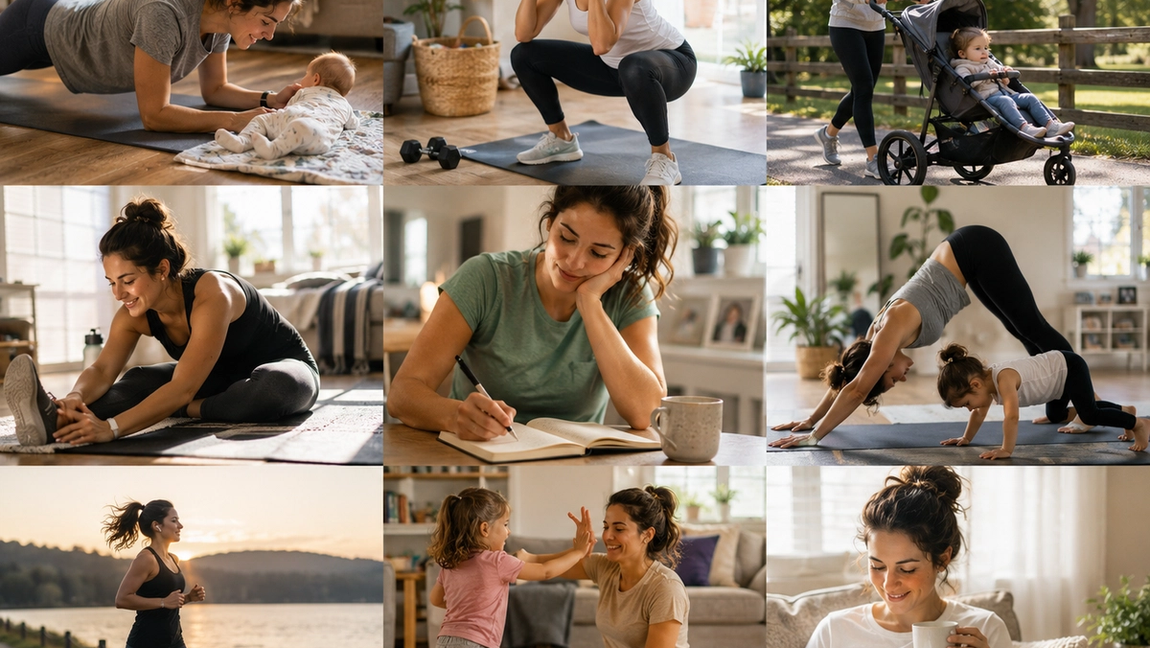
Take them on walks. Use a stroller when appropriate. Go cycling together. Dance in the living room. Let older children play nearby while you exercise at home.
These workouts may not always be peaceful or efficient. Someone may interrupt your squats to ask for a snack.
But involving children can make movement easier to integrate into family life rather than treating it as something that only counts when you escape the house alone.
It also quietly teaches children that physical activity is a normal part of adulthood.
Still protect some movement as your own time
Family movement is useful, but it is not always the same as having time to yourself.
If possible, protect some workouts where you are not simultaneously responsible for entertaining, supervising, or carrying someone else’s snacks.
A solo walk, gym session, run, class, or bike ride can provide mental space as well as physical activity.
For some mothers, this becomes one of the few predictable periods when nobody is asking them for anything.
That is valuable.
Exercise does not need to become another service you provide to the family. It can belong to you too.
Measure progress beyond weight
Weight is one possible measurement, but it is far from the only sign that movement is working.
Notice whether you feel stronger. Can you carry your child more comfortably? Walk farther without becoming tired? Lift heavier weights? Run longer? Move with less stiffness?
Also pay attention to energy, mood, sleep, and confidence.
These changes can make exercise rewarding even during periods when your appearance changes slowly or not at all.
Motherhood already creates enough opportunities to feel as though your body is being evaluated. Movement can become something different: a way to experience what your body can do.
Expect your routine to change with each season
A movement routine that works with a six-month-old may not work with a toddler. A schedule that works during parental leave may collapse after returning to work. School holidays, pregnancy, travel, illness, and changing childcare arrangements can all require adjustments.
That does not mean you lack consistency.
Consistency can mean repeatedly rebuilding your routine around your current life.
Instead of asking, “Why can’t I stick to anything?” ask, “What version of movement works for me right now?”
Sometimes the answer will be structured workouts. Sometimes it will be walking and ten minutes of strength training in the living room.
Both can keep the relationship with movement alive.
Stop using exercise as punishment
Movement becomes difficult to sustain when every workout is repayment for something you ate or punishment for how your body looks.
Try shifting the purpose.
Exercise can be how you become stronger, protect your health, manage stress, spend time outdoors, build endurance, or reconnect with your body after pregnancy and childbirth.
You are far more likely to maintain something that makes your life feel better than something designed to constantly correct you.
This also changes what happens when you miss a workout.
You do not need to compensate the next day. You simply continue.
Make returning the most important habit
No exercise routine survives motherhood without interruptions.
Children get sick. You get sick. Vacations happen. Work explodes. Sleep disappears. Some weeks, exercise simply will not be the priority.
The important skill is returning without turning the interruption into a verdict about yourself.
You do not need to wait until Monday, next month, or the beginning of a new fitness challenge. Take a walk today. Do a short workout tomorrow. Book your next class.
A sustainable movement practice is not built by never missing a session.
It is built by making it normal to begin again.
And once you stop demanding perfect consistency, movement becomes much easier to keep—not because motherhood suddenly becomes less busy, but because your routine finally knows how to live inside it.


