
How to Actually Be Present with Your Kids After a Long Day
Being present with your kids sounds simple until you try to do it at the end of a genuinely exhausting day. You walk through the door carrying unfinished work in your head, messages are still coming in, dinner needs to happen, the house is loud, and someone immediately needs something from you.
By Alice Dawson on August 19, 2026
Being present with your kids sounds simple until you try to do it at the end of a genuinely exhausting day. You walk through the door carrying unfinished work in your head, messages are still coming in, dinner needs to happen, the house is loud, and someone immediately needs something from you.
You love your children. You are also tired.
That combination can create a particular kind of guilt. You finally have time together, but part of your brain is still answering emails, thinking about tomorrow, or wondering how early you can reasonably go to bed.
Being present does not mean giving your children your undivided attention every second you are together. That is unrealistic. It means creating enough moments of genuine attention that your children regularly experience what it feels like to have you fully there.
Give yourself a transition between work and home
One reason it can be difficult to connect after work is that your body may be home while your brain is still at work.
Create a small transition ritual. If you commute, the journey itself can become one. Listen to music, walk part of the way, or simply spend the final few minutes without checking messages. If you work from home, close your laptop, change clothes, wash your face, or take five minutes alone before switching into family mode.
The ritual does not need to be long. It simply needs to signal that one part of the day has ended and another is beginning.
Without that transition, work can easily leak into the entire evening. You may technically stop working at six but continue mentally working until bedtime.
Put your phone somewhere inconvenient
Phones are remarkably good at stealing tiny pieces of attention.
You pick yours up to check one message and suddenly you are reading an email, checking the weather, responding to a notification, and looking at something completely unrelated. Meanwhile, your child has asked the same question three times.
You do not need to abandon your phone for the entire evening. Instead, create short phone-free periods.
Put it on a counter while you eat dinner. Leave it in another room during bath time. Keep it out of your hand for the first twenty minutes after you get home.
Physical distance helps because you are removing the need to repeatedly make the decision not to check it.
Twenty minutes of full attention can feel much more meaningful than two hours of fragmented attention.
Follow their world for a while
Adults naturally want to direct children’s time. We ask questions, suggest activities, teach lessons, correct behavior, and move everyone through the evening routine.
Sometimes being present means doing the opposite.
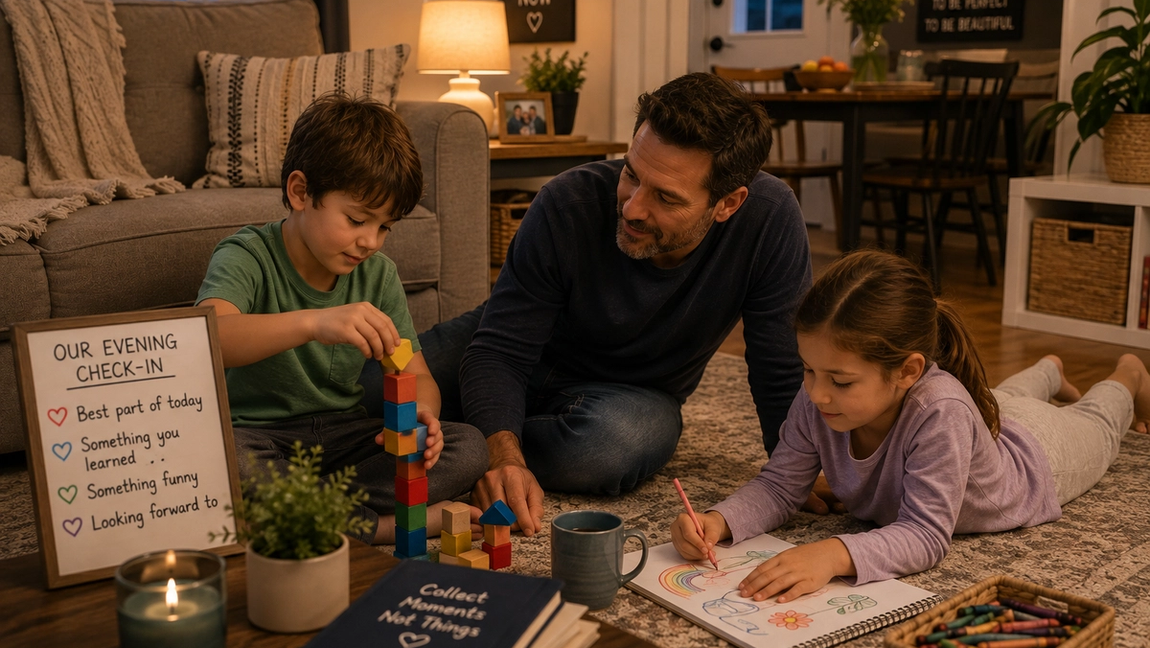
Sit down and enter whatever your child is already doing. Build the tower. Look at the drawing. Listen to the extremely detailed story about something that happened earlier. Let them choose the game.
For younger children, this might mean getting on the floor and playing for ten minutes without trying to turn the activity into something educational.
For older children, it may mean listening without immediately offering solutions.
Children often communicate most freely when they do not feel like they are being interviewed. Being interested in their world creates opportunities for connection that forced conversations rarely produce.
Stop waiting for perfect quality time
Parents can put enormous pressure on themselves to create meaningful childhood experiences.
But connection does not require a carefully planned family activity every evening.
Children often experience closeness during ordinary moments. Let them help prepare dinner. Talk while folding laundry. Play music in the kitchen. Walk the dog together. Sit on the edge of their bed for a few extra minutes.
These moments may not look particularly special from the outside, but childhood is mostly made from ordinary days.
When you stop believing that quality time needs to be impressive, it becomes much easier to create.
Use small rituals to make connection automatic
Rituals remove the need to constantly invent new ways to connect.
Maybe everyone shares the funniest part of their day during dinner. Perhaps bedtime always includes a story and a few minutes of talking. Maybe Friday evenings mean homemade pizza, or you take a short walk together after dinner.
Children begin to anticipate these moments.
Even on chaotic days, a familiar ritual gives you somewhere to reconnect. It also creates continuity during busy periods when schedules change and everyone seems to be moving in different directions.
The best rituals are usually simple enough to survive real life.
Let yourself be tired without disappearing
You do not have to perform endless enthusiasm to be a loving, present parent.
Some evenings you will not have the energy to play an elaborate game. You may genuinely need to sit down.
Let your children join you there.
Read together on the couch. Put on music. Draw at the table. Watch something together and actually watch it with them. Ask them to tell you about their day while you rest.
Presence is not measured by how energetic you are. Children can experience closeness with a tired parent.
The important difference is between being tired together and being emotionally unavailable because you are constantly somewhere else mentally.
Listen before trying to fix everything
When children tell adults about a problem, our instinct is often to immediately solve it.
Someone was mean at school? Here is what you should do. You are nervous about tomorrow? There is nothing to worry about. You are upset because your tower fell down? We can rebuild it.
Sometimes children simply want someone to understand.
Try staying with the feeling for a moment before offering a solution. Ask what happened. Let them explain. Acknowledge that something sounds frustrating, embarrassing, exciting, or difficult.
This becomes increasingly important as children get older. If every conversation immediately becomes advice, correction, or a lesson, they may eventually stop bringing things to you.
Being present sometimes means resisting the urge to turn every moment into parenting.
Give each child individual attention when you can
In families with multiple children, group time matters, but individual attention can feel particularly powerful.
It does not have to mean separate outings every week. One child might accompany you to the grocery store. Another might stay up ten minutes later occasionally to talk. You might take turns choosing who helps make breakfast.
These small one-on-one moments allow children to interact with you without competing for attention.
They also give you opportunities to notice changes that can disappear in the noise of family life.
Repair the moments when you are not present
You will lose patience sometimes. You will stare at your phone while your child is talking. You will say “in a minute” and forget. You will have evenings when work consumes more of you than you intended.
That does not erase all the other moments.
When you notice that you have disconnected, reconnect.
Put the phone down. Apologize if you snapped unnecessarily. Sit beside your child. Ask them to finish the story you were not properly listening to.
Children do not need parents who never get distracted or exhausted. They need parents who repeatedly find their way back.
Focus on moments, not hours
The pressure to “be present” can become another impossible standard for already tired parents.
Instead of measuring connection by how many hours you spend together, look for small windows when you can offer complete attention.
Ten minutes on the floor. Dinner without phones. A conversation in the car. A bedtime story you are actually listening to as you read it. A long hug when you first get home.
Children do not experience their childhood as a productivity report. They experience thousands of tiny interactions that gradually teach them whether they are noticed, listened to, and safe with you.
After a long day, you do not need to become a perfectly patient, endlessly energetic version of yourself before walking through the door.
You just need to keep creating moments when your child looks at you and knows that, right then, you are really there.


